If you live in an HOA community — and in Round Rock, Georgetown, Cedar Park, and Pflugerville, there’s a very good chance you do — this is usually the first question that comes up when you start researching permanent roofline lighting.
Will my HOA allow this?
It’s a fair question, and it deserves a straight answer: yes, permanent roofline lights are fully HOA compliant, and Zeus Illumination has installed them in HOA communities throughout the greater Austin area without issue.
But “yes” isn’t the whole story. Understanding why these systems work in HOA settings — and what makes them different from the seasonal decorations that HOAs sometimes restrict — helps you approach your specific community with confidence. This article covers everything Texas homeowners in HOA communities need to know.
Key Takeaways
Zeus Illumination permanent roofline lights are fully HOA compliant and installed in HOA communities throughout Austin, Round Rock, Georgetown, Cedar Park, and Pflugerville with no issues
The low-voltage system meets HOA electrical requirements in virtually all communities
The “hidden by day, illuminated by night” design — with color-matched, low-profile track — satisfies HOA aesthetic standards because the system is virtually invisible during daylight hours
Technical specifications for HOA submission are available at zeusillumination.com/technical-specifications
The free onsite estimate is a good opportunity to discuss your specific HOA situation before installation
The Short Answer — And Why These Systems Are Built for HOA Communities
Permanent roofline lighting — sometimes called trimlights, track lights, outdoor accent lighting, or smart lights — was designed from the ground up to look intentional and architectural. That design intent is precisely what makes it compatible with HOA aesthetic standards.
HOAs restrict outdoor decorations for a reason: they want the neighborhood to look cohesive, well-maintained, and finished — not like individual homeowners are doing whatever they feel like on any given weekend. Temporary holiday lights, visible extension cords, mismatched hardware left on homes past season — these are the things HOA rules are written to prevent.
Permanent LED roofline lighting is the opposite of all of that. It’s professionally installed, architecturally integrated, and designed to disappear into your home’s exterior during the day. It doesn’t read as a decoration. It reads as a home feature — which is exactly what it is.
Zeus Illumination has installed permanent Christmas lights, permanent holiday lights, and year-round outdoor accent lighting in HOA communities across the Austin metro without issue. That’s not luck — it’s design.
The Three Reasons Permanent Roofline Lights Work in HOA Settings
1. Hidden by Day — The Aesthetic That HOAs Accept
Zeus Illumination’s core design philosophy is “Hidden by day, illuminated by night.”
Every installation uses a low-profile track system that sits flush against your fascia and is color-matched to your home’s specific fascia color. During daylight hours, the track blends into your roofline so completely that most people standing on the sidewalk in front of your house cannot tell it’s there.
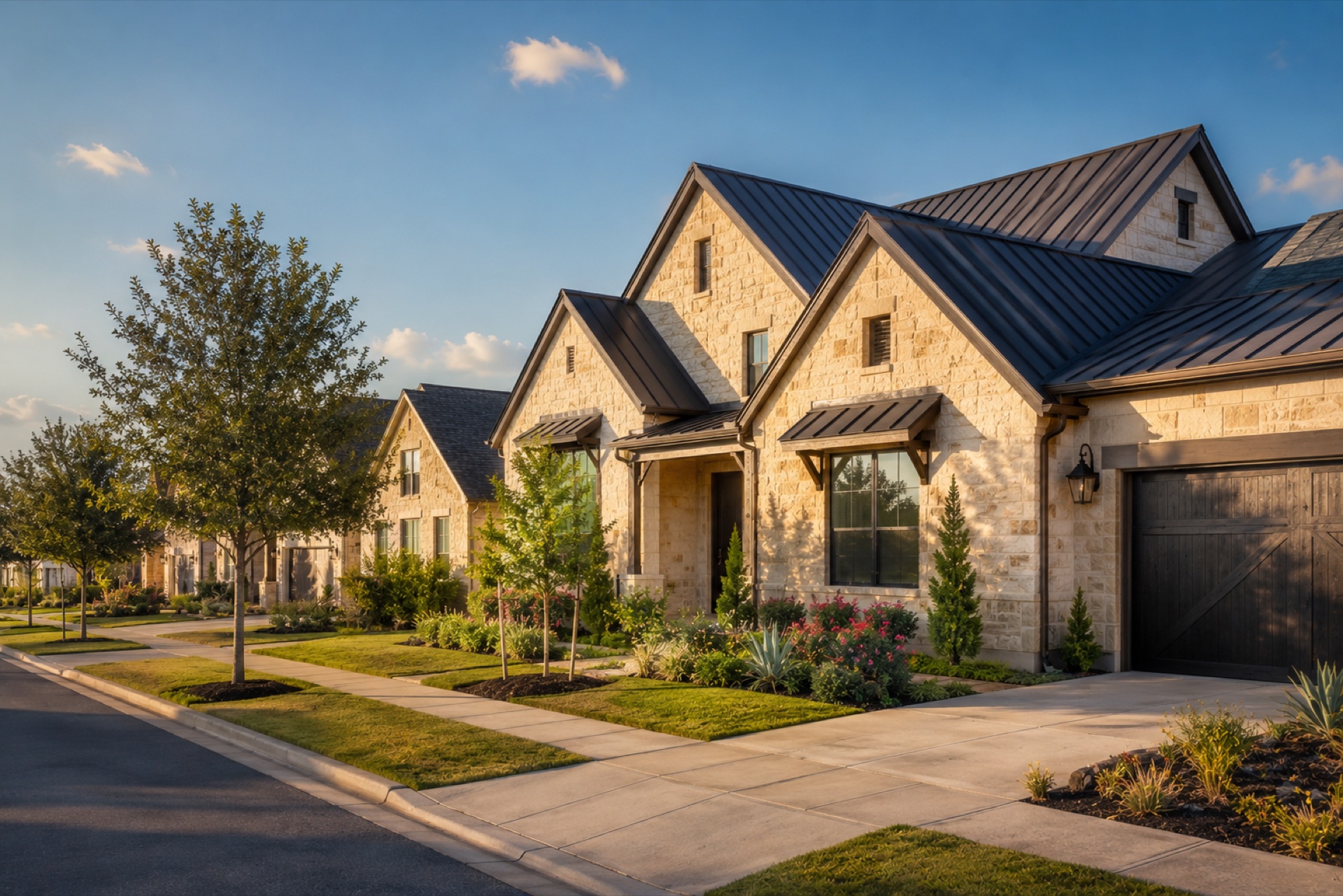
This is the feature that matters most in HOA contexts. HOA architectural guidelines exist to protect the visual consistency of the neighborhood during the hours when everyone can see it — during the day. A system that’s invisible during the day doesn’t conflict with those guidelines. It honors them.
When neighbors or HOA board members see your home after installation, the daytime view is exactly what it was before: a clean, well-maintained roofline. What changes is what happens after sunset.
2. Low Voltage — Meeting Electrical Standards
The permanent LED lighting systems Zeus Illumination installs operate on low-voltage power. Low-voltage outdoor lighting is the standard in residential exterior lighting — the same technology used in landscape lighting, pathway lighting, and architectural accent lighting that HOA communities approve and often encourage.
In virtually every HOA community across Round Rock, Georgetown, Cedar Park, Pflugerville, and the broader Austin metro, the low-voltage specification of our permanent roofline lights places them squarely within acceptable parameters for exterior electrical improvements.
3. Permanent and Professional — Not Seasonal and DIY
HOA restrictions on holiday decorations typically target temporary installations — things that go up in November, clutter the exterior of the home for weeks, and create visual inconsistency. Permanent roofline lighting is categorically different. It’s a professional installation, done once, with no recurring setup or takedown. There’s no seasonal clutter, no temporary hardware, no extension cords.
From an HOA perspective, a permanent professional installation is fundamentally different from a seasonal decoration. It’s an exterior home improvement — and it’s evaluated as such.
HOA Communities in Round Rock, Georgetown, Cedar Park, and Pflugerville
Round Rock
Round Rock has some of the most active HOA communities in the Austin metro — Teravista, Forest Creek, Paloma Lake, Mayfield Ranch, Walsh Ranch, Behrens Ranch, Brushy Creek, Sonoma, and Vizcaya among them. We have installed permanent holiday lights and roofline accent lighting in Round Rock HOA communities including those listed above. In each case, the low-profile, color-matched system passed without issue.
Georgetown and Sun City Georgetown
Georgetown’s neighborhoods range from established communities near the historic square to the massive Sun City Georgetown — one of the largest 55+ active adult communities in Texas, with its own comprehensive HOA structure. The “hidden by day” design approach is exactly what makes permanent roofline lighting work within Sun City’s framework: the daytime look is clean and unobtrusive, and the nighttime display is elegant rather than flashy.
Cedar Park
Cedar Park HOA communities — including 1890 Ranch, Twin Creeks, Buttercup Creek, Anderson Mill West, and the Avery Ranch corridor — maintain high standards for exterior home appearance. Because Cedar Park homes are largely newer construction, HOA boards in these communities are also generally more familiar with permanent outdoor LED lighting as a home feature.
Pflugerville
Pflugerville’s HOA communities — including Falcon Pointe, Springbrook, Avalon, and Villages of Northtown — have grown rapidly alongside the city itself. The combination of professional installation, low-voltage electrical, and the virtually invisible daytime profile addresses the criteria most Pflugerville HOAs apply to exterior modification requests.
If Your HOA Asks for Technical Specifications
Some HOA communities — particularly those with formal architectural review committees — will ask you to submit product specifications before approving an exterior change.
If your HOA requests technical documentation for your permanent roofline lighting installation, everything you need is available at:
zeusillumination.com/technical-specifications
This page includes detailed specifications for the LED track system, fixture components, and electrical specifications — the information an architectural review committee would typically want. Download it, submit it, and let the specs speak for themselves.
Most homeowners don’t need to go through a formal HOA approval process for permanent roofline lighting. But if your community has a formal review process for any exterior modification, having the specs document ready makes that process straightforward.
What to Do Before Your Installation If You Have an HOA
Step 1: Review your HOA CC&Rs. Look specifically for language around exterior lighting, permanent exterior modifications, and electrical installations.
Step 2: Book your free onsite estimate. During your estimate visit, mention that you’re in an HOA community. We can discuss your specific situation and make sure the installation plan accounts for any community-specific considerations.
Step 3: If review is needed, use our specs page. Download the technical specifications from zeusillumination.com/technical-specifications and submit them with your request.
Step 4: Schedule installation. Most installations in the Round Rock, Georgetown, Cedar Park, and Pflugerville area are completed within a week of booking, often sooner.
Frequently Asked Questions
Q: Has Zeus Illumination ever had an installation rejected by an HOA?
A: We have installed permanent roofline lights in HOA communities throughout the greater Austin area without issue. The design of our system — low-profile, low-voltage, color-matched, professionally installed — addresses the criteria that HOA architectural guidelines are written around.
Q: Will my HOA notice the lights during the day?
A: That’s exactly the point of the “hidden by day” design. The color-matched track sits flush against your fascia and is virtually invisible from normal viewing distances during daylight hours.
Q: What if my HOA has rules about holiday decorations?
A: HOA rules around holiday decorations typically target temporary seasonal installations. Permanent roofline lighting is a different category: a permanent exterior home improvement, not a seasonal decoration.
Q: Do I need to notify my HOA before installation?
A: That depends on your specific community’s rules. Reviewing your CC&Rs and, if needed, submitting the technical specifications is the right approach if you’re unsure.
Q: Can the lights be turned off completely if needed?
A: Yes. The system is fully controlled through an app — you can turn lights off entirely, dim them, or schedule them however you want.
Q: What colors are appropriate for an HOA setting?
A: The warm white everyday setting is what most HOA community homeowners run by default — it’s subtle, elegant, and looks like high-end architectural accent lighting rather than a festive display.
Ready to Talk About Your Specific HOA Community?
Our gallery at zeusillumination.com/gallery shows permanent roofline lighting on real Austin-area homes — including the clean daytime profile that makes HOA compliance straightforward.
Zeus Illumination is a local, family-owned business serving homeowners throughout Round Rock, Georgetown, Sun City, Cedar Park, Pflugerville, Austin, Leander, Liberty Hill, Hutto, Kyle, Buda, San Marcos, Dripping Springs, Wimberley, New Braunfels, and across the Texas Hill Country.